On Aug. 7 the Labor Department reported that American employers cut 23,000 jobs in July, and quietly revised May and June down by a combined 103,000. The unemployment rate held at 4.1%, so the story died in a news cycle. It shouldn't have. The revisions showed that the labor market stopped growing sometime this spring and almost nobody noticed, because this economy has one engine left, and that engine doesn't hire many people.
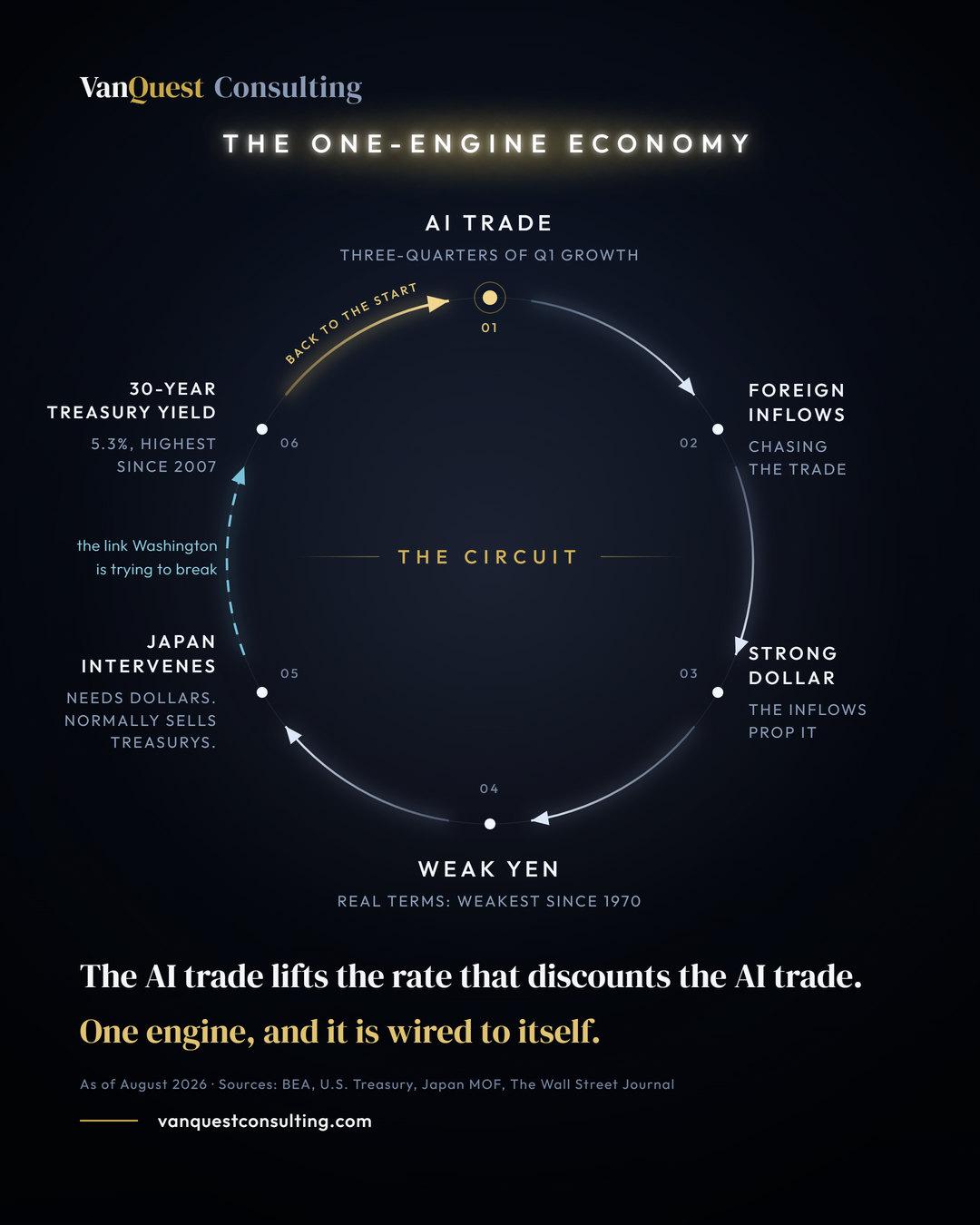
The engine is artificial-intelligence capital spending. In the first quarter, information-processing equipment and intellectual-property products contributed roughly 1.55 percentage points of the 2.1% annualized growth rate. Three-quarters of the expansion came from servers, chips and the warehouses built to hold them. Second-quarter growth slowed to 1.5%. Take that away and there isn't an expansion to discuss.
There is nothing wrong with a capital boom. The problem is an economy that has only one, and a boom that has begun destabilizing the thing its own economics depend on.
What a capital boom does not do
Start with what capital spending doesn't do. It doesn't hire. July's losses came from local-government education, down 50,000, and retail, down 19,000, against health-care gains of 22,000 that were themselves slowing. Average hourly earnings rose 3.2% over the year while consumer prices rose 3.4%. The typical worker is losing ground while the growth statistic looks respectable, and the second fact is what politicians read.
Three trillion dollars that never reaches the capex line
Then consider how much has been committed, which is not what the capital expenditure line says. Hyperscaler capex ran about $600 billion over the past year. But a Wall Street Journal analysis published Sunday found nine large technology companies carrying some $3 trillion of obligations that sit off their balance sheets, roughly triple what they report in leases and long-term borrowings. Alphabet's purchase commitments went from $332 billion to $811 billion in a single quarter. Signed leases and purchase orders, for the most part, cannot be cancelled.
The engine is not merely large. It has committed to running at this speed for years, whether or not the revenue arrives.
How it is paid for compounds that. Meta's Hyperion campus in Louisiana is owned by a venture 80% held by Blue Owl Capital funds and financed with a $27.3 billion bond maturing in 2049. Meta's committed lease runs four years, beginning in 2029, and totals about $12.3 billion. That is 45% of the paper. The rest rests on renewal options and on Meta's promise to make bondholders whole if it leaves before twenty years are up. Meta does not consider payment probable, so it records no liability. Michael Cembalest of J.P. Morgan Asset Management calculates that consolidating Hyperion would take Meta's net debt to EBITDA from 37% to 63%. The Bank for International Settlements calls the category shadow borrowing.
The Enron feature that survived, and it isn't the fraud
Somebody always raises Enron here, and the objection deserves a straight answer. Gil Luria of D.A. Davidson gives the right one: Enron's crime wasn't having special purpose vehicles, it was hiding them. Enron's entities failed the consolidation tests then in force, there were secret side agreements and back-dated documents, and a chief financial officer took more than $30 million from both sides of the table. Nothing on the public record here resembles that. Blue Owl's 80% is real money at real risk, and the Journal built its $3 trillion figure out of the companies' own footnotes.
But one Enron feature has survived, and it is not the fraud. The Raptors, Enron's hedging vehicles, were capitalized with Enron's own stock, which meant they were guaranteed to fail at the precise moment they were needed. Look at what is being built now. Broadcom guarantees the residual value of the chips in the $35 billion vehicle Apollo and Blackstone assembled for Anthropic. Nvidia said on Aug. 11 it would seed up to $500 billion of debt pools secured by compute and take up to a quarter of a transaction itself. Bloomberg counted roughly $70 billion of such backstops last weekend.
Here is the part a cash-flow practitioner notices. A guarantee is worth something only if the guarantor is solvent in the state of the world that triggers it. What triggers these? Revenue arriving late, buyers missing payments, used accelerators repricing. That is one event, not three, and it is the same event that guts the revenue of the guarantors, because the guarantors sell the hardware. Insurers call this wrong-way risk. It is the Raptor defect without the crime.
Even the owners disagree about what the collateral is worth. Microsoft, Alphabet and Meta all extended the useful lives of their servers, booking billions in avoided depreciation. Amazon went the other way, shortening part of its fleet back to five years and giving a reason: the increased pace of technology development. The revenue servicing all of this is forecast, not contracted. A receivable and a hope are not the same asset, and neither is a guarantee and a guarantor.
Now add the fiscal position
Now add the fiscal position, which turns a concentration problem into a circuit.
Gross federal debt has exceeded the size of the American economy in only two periods since the founding. The first was the years around World War II. The second began in 2013 and has not ended. On the narrower measure the Congressional Budget Office uses, debt held by the public reaches about 100% of GDP this year and breaks the 1946 record of 106% in 2030. Interest will cost about $1 trillion this year, 3.2% of GDP, making debt service the third-largest line in the budget, behind Social Security and Medicare and ahead of defense.
The comparison to 1946 is usually offered as reassurance. We carried more than this once and grew out of it. The trouble is that we didn't, mostly. An IMF study by Acalin and Ball decomposed the fall from 106% in 1946 to 23% in 1974 and found growth accounts for roughly a third of it. The larger share came from primary surpluses and from what the authors call interest-rate distortions: the Federal Reserve pegged bond yields from 1942 until the Treasury-Fed Accord of 1951, and surprise inflation did the rest, under wartime price controls. Their conclusion is blunt, that those distortions are unlikely to recur. Today's debt also carries a much shorter average maturity, which limits how much inflation can erode it. RAND calculates that repeating the postwar paydown through growth alone would take 3.2% real growth every year for thirty years, roughly double what the CBO projects.
So the precedent everyone reaches for is not a growth story. It is a story about a central bank that subordinated monetary policy to the management of the debt. Hold that thought.
The rate that discounts everything
The 30-year Treasury yielded 5.27% on July 31, the highest since 2007, and on Aug. 13 a $25 billion auction cleared at the highest yield since 2001, with dealers stuck holding 11.5% of the issue. That yield is the discount rate under every long-horizon project in the country, including the data centers.
Then watch what happened last month.
Foreign capital chasing the American AI trade has been holding the dollar up, which helped push the yen to its weakest against its trading partners, adjusted for inflation, in data going back to 1970. Japan intervened on July 30 and again, jointly with Washington, on July 31. When Tokyo intervenes it needs dollars, and the customary way to raise them is to sell Treasurys. Japan owns $1.14 trillion of them, more than any other foreign holder, and sold $66.8 billion in one month to fund its May intervention.
So Washington bought yen with euros rather than dollars, and Treasury Secretary Scott Bessent began publicly pressing the Federal Reserve to lift the $60 billion cap on the facility that lets foreign central banks raise dollars by pledging Treasurys instead of selling them. Mark Sobel, who ran international monetary policy at Treasury, calls a public request like that highly unusual. Goldman Sachs reads the purpose plainly: to avoid abrupt upward pressure on American rates from a large holder selling into the market.
Washington is not doing Tokyo a favor. It is defending the price of its own debt, and the reason that price matters so much now is that the only sector still growing is the one most sensitive to the long end.
That is the circuit. The AI trade attracts the foreign capital that props the dollar that crushes the yen that forces the intervention that would sell the Treasurys that raise the rate that discounts the AI trade.
Cut the wire and the current goes somewhere
So what happens when somebody cuts that wire? The current has to go somewhere, and where it goes is the Federal Reserve's balance sheet. Japan pledges Treasurys instead of selling them, the Fed supplies the dollars, and the pressure leaves the bond market and reappears as bank reserves.
Do that at scale and it has a name. Fiscal dominance is the condition in which a central bank can no longer set interest rates for the economy because it has to set them for the debt. It is not a theory. It is what the United States ran from 1942 to 1951, and it is most of the reason the last debt of this size went away.
The consequence is not a crisis. It is quieter than that and worse. A Fed that cannot raise rates without breaking the budget will not raise them, so the adjustment happens in the currency and in prices instead. Debt at that point is not repaid. It is diluted.
Why a falling debt ratio can be bad news
That word is doing precise work. A company can cut its debt-to-equity ratio by earning more money or by issuing a mountain of new shares. Both improve the ratio, and existing shareholders feel very differently about the two. Debt to GDP falls the same three ways. Real growth, which costs nobody anything. Surpluses, which voters choose and know they are paying for. Or inflation, which nobody votes on and savers fund without ever seeing a transaction. All three draw an identical chart. The ratio is not a scoreboard. It is a symptom, and it can improve for a bad reason.
The inflation route also closes behind you. Bond buyers price in what they expect, so the yield rises, which raises the interest bill, which increases the pressure to hold rates down, while investors stop lending long and the average maturity shortens, so the whole stock reprices faster the next time. Each turn buys less relief and leaves a larger interest bill on arrival. This is the mechanism that turns a heavy debt into a permanent one.
The one line that would tell you it has started
Nobody in Washington is proposing any of that. What is actually happening is smaller, and it is measurable. The Federal Reserve publishes its balance sheet every Thursday, and one line on it records repurchase agreements with foreign official institutions. For the week ended Aug. 12 it read zero, as it had for eight straight weeks. Last month's interventions were funded the old way.
The day that line prints a number, a central bank sitting on $1.14 trillion of Treasurys has decided it would rather borrow from the Federal Reserve than sell into the open market. That is a judgment about what the market can absorb, made by someone who knows precisely how it trades. It is free, it is published weekly, and almost nobody reads it.
Where to find it yourself
The release is the Federal Reserve's H.4.1, published every Thursday afternoon at federalreserve.gov/releases/h41. The line is Repurchase agreements: Foreign official, in the table of factors supplying reserve balances.
Zero means foreign central banks raised their dollars in the market. A number means at least one of them chose to borrow against its Treasurys rather than sell them, and the sequence in this article has moved one step forward.
Growth is the only exit from a debt this size that costs nobody anything. We have wired our one growth engine to the rate that closes it, so the harder the engine runs, the faster the door shuts.
Monetary policy has no clean move inside that. The Fed held at 3.50% to 3.75% in July on a 9-3 vote, with three dissents favoring a hike. But this inflation isn't demand. Tariffs pushed the average effective tariff rate to 7.1% from 2.3% in January 2025, and gasoline went from $2.98 to above $4 after Strait of Hormuz disruptions. Monetary policy answers supply shocks by destroying demand, which means raising rates into a labor market that just shed jobs, while the Treasury asks it to expand a facility at the moment it thinks it should be shrinking one.
Where it breaks first is appetite, not spreads
Nothing here requires a default to hurt. The transmission runs through appetite. When a company sells a bond, the banks collect orders before pricing it, and the ratio of orders to bonds tells you how long the queue is. Hyperscaler deals that drew nearly five dollars of demand for every dollar offered in February drew less than two by July. Spreads haven't blown out, and this is not a distress signal. It is an appetite signal, and appetite turns first, because it measures the room left for the next deal rather than the price of the last one. Roughly $50 billion to $60 billion of supply is queued for after Labor Day. If it prices wide, the marginal project doesn't get financed, capex guidance gets trimmed, and the 1.55 points of growth that were three-quarters of the expansion stop arriving, into a labor market that stopped growing in the spring.
Four things would help
Restore the disclosure Enron already bought us once. Sarbanes-Oxley produced an SEC rule requiring a standardized table of contractual obligations, purchase commitments included, in every annual report. The SEC deleted that table in 2020, five years before this cycle. Bringing it back is cheap, it is precedented, and it would let anyone compare nine companies on one page. The Financial Accounting Standards Board opened a research project on data infrastructure financing in April. A table would arrive faster.
Stop letting the seller insure the collateral. If residual value on AI hardware needs guaranteeing, and the market has decided it does, it should be guaranteed by someone whose ability to pay does not depend on the same forecast.
Fix the supply side Washington controls. The binding constraint on data centers is electricity and interconnection queues, not capital.
And put the debt on a schedule, because if Congress doesn't set one the bond market will, in the only language it has. Every auction that clears at a higher yield is another line in that schedule, written by somebody nobody elected. Aug. 13 was the highest in twenty-five years.
Over open water
A single-engine aircraft is not unsafe. It becomes unsafe when you fly it over open water with no plan for engine failure. We are over water, and the gauge that would show how much fuel is left was taken off the panel in 2020.
The same discipline, one company at a time
Everything above is the macro version of a question we answer weekly for individual businesses: which commitments are contractual, which revenue is forecast, and what the gap does to cash inside the next thirteen weeks. VanQuest delivers institutional-quality cash flow analytics to companies that could not previously access it.
Start a conversationThis article is general information and commentary, not financial, legal, or investment advice, and it is not a recommendation to buy or sell any security. Figures are as of August 2026 and are drawn from public sources, which are named in the text: the Bureau of Labor Statistics employment situation release of Aug. 7 and the Bureau of Economic Analysis GDP releases, on jobs, revisions, earnings and the composition of growth; a Wall Street Journal analysis of off-balance-sheet obligations across nine technology companies, and those companies' own filings and footnotes on purchase commitments, lease terms and useful-life estimates; Michael Cembalest of J.P. Morgan Asset Management on the consolidation arithmetic at Hyperion; the Bank for International Settlements on shadow borrowing; Gil Luria of D.A. Davidson on the distinction from Enron; Bloomberg on the scale of vendor backstops; Congressional Budget Office projections for debt held by the public and net interest; Acalin and Ball, International Monetary Fund, on the decomposition of the postwar debt paydown; RAND on the growth rate a repeat would require; U.S. Treasury auction results and Treasury International Capital data on foreign holdings; Japan's Ministry of Finance on intervention; Goldman Sachs and Mark Sobel on the swap and repo facility; and the Federal Reserve H.4.1 statistical release for the foreign official repurchase agreement line. Readers should check the current H.4.1 print before relying on the figure quoted here.